
Karen Blixen’s flowers – The art behind the storyteller
The great storyteller Karen Blixen is world-renowned for her captivating literary works as well as for her adventurous life as a baroness on a coffee farm in Kenya. Yet, throughout her remarkable career, the visual arts ran like a red thread, and one of her rare paintings is now coming up for auction.
|
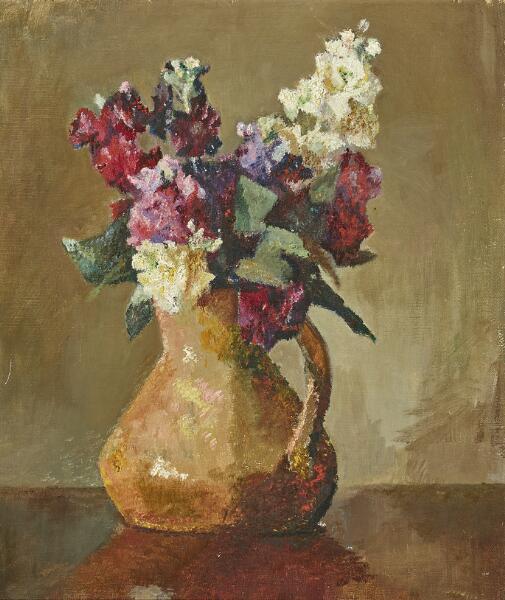
At this year’s first Live Auction on 9 March, we are privileged to present a particularly rare work: a still life by Karen Blixen (1885–1962) depicting flowers arranged in a jug. The composition offers a sensuous interplay between the soft, organic forms of the colourful blooms and their reflection in the polished tabletop. Blixen’s lifelong passion for flowers – and for arranging them in vases – finds exquisite expression in this beautiful painting. |

|

|
Exceptional provenanceMost of Karen Blixen’s paintings are preserved at Rungstedlund, north of Copenhagen – her Danish home, now the Karen Blixen Museum. It is therefore something of a rarity for one of her works to appear in private collections and on the auction market. The floral painting offered here was painted at Rungstedlund around 1920, during a period when Blixen, due to illness, stayed in Denmark while living in Kenya. As such, it represents a significant transitional moment in her life between Africa and Denmark. The painting has until today been owned by the Ahlefeldt-Laurvig family and was likely given as a gift by Blixen to Countess Christine Ahlefeldt-Laurvig, who in her younger years was part of the circle around the author. In 1938, Ahlefeldt-Laurvig married the artist Erik Clemmesen, who illustrated several of Blixen’s texts. |

“Art in all its forms has meant infinitely much to me. And I believe that painting has had the most directly inspiring effect on my mind.”
Karen BlixenQuoted from the exhibition catalogue “An Artist’s Eye – Karen Blixen and the Visual Arts”

|
With brush and canvasAlthough Karen Blixen is first and foremost celebrated as a writer, this quotation reveals the profound joy she found in painting – and how the visual arts served as a vital source of inspiration. It underscores how essential art was to her – not only as a means of expression but as a fundamental way of viewing the world aesthetically. |
|
In fact, painting was initially the path she intended to pursue. At seventeen, she began taking drawing lessons and continued her studies from 1903 to 1906 at the Royal Danish Academy of Fine Arts’ School for Women. In 1906, she was accepted into the Academy’s model school but apparently did not take up her place. In 1910, she went to Paris to study painting privately, a clear sign of her sustained artistic ambition. In 1912, Blixen became engaged to her cousin, the Swedish nobleman Bror von Blixen-Finecke. The two shared a spirit of adventure and travelled to Kenya, where they purchased a coffee plantation at the foot of the Ngong Hills southwest of Nairobi. Blixen lived in Africa from 1914 to 1931, and during these years, painting offered her an essential creative refuge. She loved depicting the landscape, nature, and the people who worked on the farm. In her letters home, she described how deeply fulfilling painting could be. |
“When I can stand here painting – and it goes reasonably well – and it is raining on the farm, and the air is as fine and fresh as it gets here in the rainy season, I think it is a pleasure to be alive.”
Karen Blixen,Quoted from An Artist’s Eye – Karen Blixen and the Visual Arts

|

|

|
Behind the Storyteller
Karen Blixen was a true cosmopolitan. After her divorce from Bror and the bankruptcy of the coffee farm, she left Africa in 1931 – deeply affected by the tragic death of her great love, Denys Finch Hatton, in a plane crash. Back in Denmark, she began in earnest the literary career that would make her one of the most celebrated figures in Danish cultural history. Writing under the pseudonym Isak Dinesen, she produced works that combined classical genres such as magical realism and painterly settings reminiscent of fine art with a distinctly modern worldview. |
|
She transformed her personal experiences into grand, universal narratives that first gained recognition abroad. Her international breakthrough came in 1934 in the United States with the short stories “Seven Gothic Tales”, which was published in Denmark the following year as “Syv fantastiske fortællinger.” In 1937 came “Out of Africa”, followed by several other major works. During her 1959 visit to the United States, she was received as a superstar, appearing in the media alongside icons such as author Arthur Miller and actress Marilyn Monroe. Karen Blixen defies classification. She expressed herself through different art forms and across continents. The small painting presented at auction stands as a beautiful reflection of the artistic energy and aesthetic sensibility that permeated her entire life and oeuvre. |
|
|
Julie Arendse VossJulie Arendse VossHead of department / Fine Art / København |