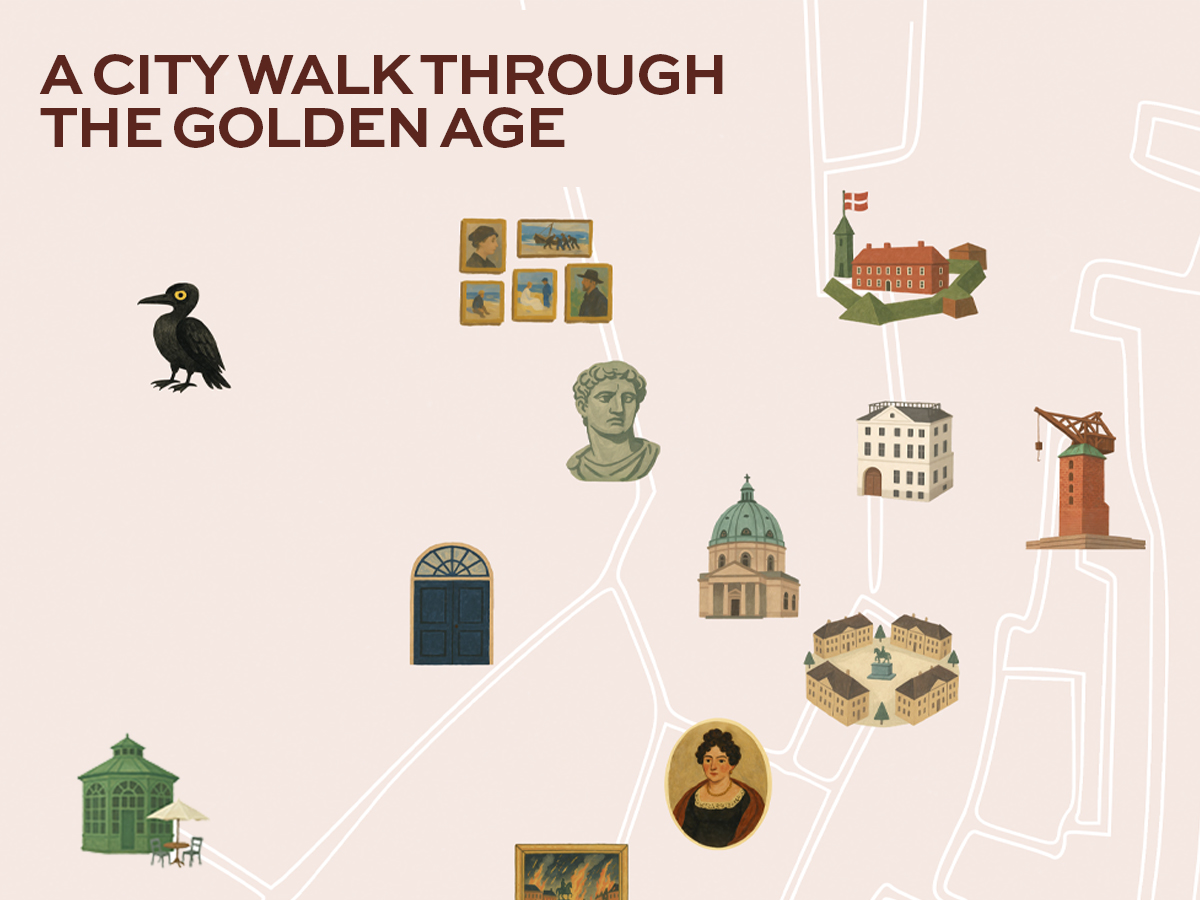
Go on a digital city walk on your own. With our map, you will be brought back to Copenhagen in the first half of the 1800s. You will follow in the footsteps of the Golden Age painters and pass by important locations in city life – from Charlottenborg and Marmorkirken to the salon hostess's residence and the lakes.
In the first half of the 19th century, Denmark was in crisis — Copenhagen bombed, navy lost, and the state went bankrupt. Paradoxically, the cultural life flourished. Great Danes such as the fairy-tale writer Hans Christian Andersen, philosopher Søren Kierkegaard, and physicist Hans Christian Ørsted contributed to rebuilding a strong national identity. Meanwhile, Golden Age painters captured Copenhagen’s everyday life and surroundings, creating some of the greatest art works in Danish history.

|
1. Charlottenborg, a baroque building from the 1670sThe Royal Danish Academy of Fine Arts from mid 18th Century. Known as the "Father of the Danish Golden Age," professor Christoffer Wilhelm Eckersberg lived here from 1818–53 and taught students like Christen Købke, Martinus Rørbye, Constantin Hansen, and Wilhelm Marstrand – the later leading Golden Age artists. They all hung out at Eckersberg's residence. |

|
2. Kongens Nytorv (The King’s New Square), founded in 1670 by Christian VIn 1807, during the Napoleonic Wars, England bombed Copenhagen and set the city on fire. Several Golden Age painters captured the bombardment from various locations in the city. C.A. Lorentzen depicted it from Kongens Nytorv. |

|
3. Amalienborg Palace, rococo complex from 1750s by architect Nicolai EigtvedAmalienborg Palace is the residence of the Danish royal family. In the middle of the octagonal courtyard is the French sculptor J.F.J. Saly’s equestrian statue of Frederik V. The place is a time capsule, as it looks exactly like it did during the Golden Age. The painters passed through here regularly on their way to and from the Academy. |

|
4. Marmorkirken/ Frederik's Church, opened in 1894Like Amalienborg Palace, Marmorkirken is part of the large urban planning project, 'Frederiksstaden,' initiated by Frederick V in 1749. During the Golden Age, the area was a major construction site and resembled them of ancient ruins in Rome. Many Golden Age artists depicted this motif. |

|
5. Amaliegade 45The childhood home of one of the greatest painters of the Danish Golden Age, Martinus Rørbye. He loved to depict everyday life in the streets of Copenhagen – and at many of his travel destinations. |

|
6. Moltke’s Mansion, built in 1702One of the 19th-century female intellectual figures was the writer Frederike Bruun. She hosted salons at Moltkes Mansion for the cultural elite, including the Golden Age painters. These salons followed European traditions, offering opportunities to enjoy art, music, and discuss the great questions of the time. |

|
7. The harbour, view of the The Masting Crane from around 1750One of the favourite motifs for Golden Age painters was the sea. This was especially true for Christoffer Wilhelm Eckersberg, who studied the nature of ships and the effects of light and weather on the sea. Many of the Golden Age painters frequented this harbour area, which was much livelier back then as the centre of international trade. Several of the painters depicted a present landmark – The Masting Crane on the opposite side of the harbour. |

|
8. The Citadel, founded by Christian IV in 1600sThe Citadel, characterized by its pentagonal shape and encircling moat, is one of the best-preserved fortresses in Northern Europe. During his childhood, the Golden Age painter Christen Købke lived here, as his father was the baker of the place. Købke frequently drew inspiration from this location for his depictions. |

|
9. Sortedam Dossering, lake established in the 17th CenturyThe lake supplied the residents of Copenhagen with drinking water in the 19th century. But it also served as a social meeting place and recreational area. The idyllic surroundings were perfectly suited for the Golden Age painter’s depictions. Christen Købke lived here and captured the lakes and local life. |

|
10. The Hirschsprung Collection, founded in 1911Tobacco manufacturer Heinrich Hirschsprung donated his collection of 19th-century art to the Danish state on the condition that a special building should be constructed to house the collection. Experience some of the most famous artworks of the Danish Golden Age. |

|
11. The National Gallery of Art, founded in the late 19th century700 years of Danish and international art set in beautiful surroundings in the park "Østre Anlæg". Featuring the largest collection of Danish Golden Age masterpieces. |

|
12. The David Collection, founded in 1948The David Collection was established by C.L. David, a notable lawyer who donated his art collection to future generations, in the building that once served as his private residence. The museum houses, in addition to Islamic art, a fine collection of Danish Golden Age art. |

|
13. Thorvaldsen's Museum, designed by architect Michael Gottlieb Bindesbøll and opened in 1848Bertel Thorvaldsen was the most internationally known Golden Age artists. He was a sculptor and spent most of his life in Rome. He bequeathed his works to the Danish state, and the building is designed as a temple inspired by ancient Pompeii and Herculaneum. The place houses his many sculptures, drawings, and archives – and not least his extensive collection of works by other artists, including the masters of the Golden Age. |

|
14. Bakkehuset (The Hill House), built in 1674Bakkehuset is an authentic Golden Age home. The couple Kamma and Knud Lyne Rahbek owned the house from 1802 to 1830 and made it a cultural gathering place for the great personalities of the Danish Golden Age. Here, the era’s great ideas, science, dialogues, and creativity flourished. Today, the house operates as a museum. |